

Jacob–Frye PIT LGD: From Concept to Practical Application
This article explains how the Jacob–Frye approach can be applied in practice to derive Point-in-Time LGD under IFRS 9, linking recovery behavior to changing macroeconomic conditions. Using a consumer portfolio example, we show how PIT LGD responds to economic stress while remaining stable, explainable, and anchored to long-run recovery assumptions—supporting robust and audit-ready ECL outcomes.
Syed Muhammad Danyal
1/13/20263 min read


Under IFRS 9, Loss Given Default is expected to move with economic conditions rather than remain static. In stressed environments, recoveries weaken, while in improving conditions, recoveries strengthen. The Jacob–Frye approach addresses this requirement by linking LGD behavior directly to the prevailing default environment.
The core idea is simple and intuitive: when portfolio default risk increases, loss severity also tends to increase, reflecting lower recoveries during economic downturns. Instead of relying on unstable macro-LGD regressions, the Jacob–Frye method produces a smooth, monotonic, and economically consistent adjustment of LGD from through-the-cycle to point-in-time levels.
Jacob–Frye PIT LGD Framework
The Jacob–Frye approach derives point-in-time LGD by linking recovery severity to the prevailing credit environment. The methodology operates within a one-factor latent credit risk framework in which both default frequency and recovery outcomes are influenced by a common systematic risk driver.
The model assumes that:
Long-run (through-the-cycle) Probability of Default and Loss Given Default represent unconditional portfolio behavior.
Deviations from long-run conditions reflect changes in the underlying economic environment.
As credit conditions deteriorate and default rates increase, recoveries decline in a consistent and monotonic manner.
Point-in-time LGD is obtained by conditioning recovery expectations on the same systematic factor that drives portfolio default behavior. This ensures internal consistency between PD and LGD while preserving the long-run expected loss implied by historical data.
The methodology does not rely on direct macroeconomic regressions and avoids manual overlays. Instead, it produces smooth, economically intuitive LGD adjustments that respond naturally to changes in portfolio credit conditions.
Illustrative Example
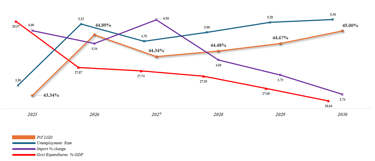
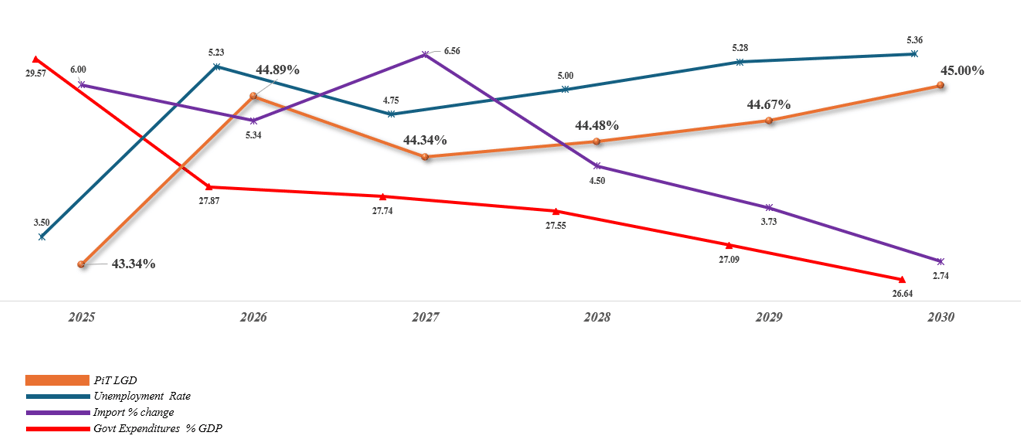
To demonstrate this behavior, a forward-looking example has been constructed for consumer portfolio using Jacob-Frye methodology, incorporating key macroeconomic indicators and projected portfolio default rates over the forecast horizon.


The above illustration shows that the PIT LGD responds concurrently to changes in macroeconomic conditions, moving from lower values in stable periods to higher values under worsening Macro economic conditions.
Given that the portfolio under consideration is a consumer portfolio, LGD sensitivity is most pronounced with respect to unemployment and import trends. As unemployment rises, borrower repayment capacity weakens, leading to higher default rates and lower recoveries. At the same time, declining import activity signals broader economic slowdown, further amplifying credit stress. Together, these dynamics result in an increase in portfolio default rates and a corresponding upward adjustment in PIT LGD over time.
The directional relationships observed are intuitive and consistent with economic theory:
Unemployment shows a strong positive relationship with default rates and LGD.
Imports and government expenditure exhibit a negative relationship, where declining economic activity and fiscal support are associated with worsening credit outcomes.
The resulting PIT LGD path remains stable, explainable, and anchored to long-run recovery assumptions.
This example highlights how the method naturally captures LGD cyclicality without abrupt shocks or manual overlays, making it particularly suitable for IFRS 9 ECL modeling.


Implementation Using Probmatrix IFRS 9 Add-In ®

Probmatrix IFRS 9 Excel Add-In ® fully supports Jacob–Frye–based PIT LGD calculation, enabling users to:
Convert TTC LGD into PIT LGD using significant MEVs
Ensure consistency between Portfolio PD and LGD movements
Perform scenario-based PiT LGD projections
All outputs generated using this framework are used as inputs to IFRS 9 Expected Credit Loss calculations.
Summary
The Jacob–Frye approach estimates PIT LGD by linking recovery behavior to changes in the credit environment, ensuring LGD increases as default risk rises. It provides a smooth, economically intuitive adjustment from long-run LGD without relying on unstable regressions. Probmatrix IFRS 9 Excel Add-In ® implements this methodology to deliver transparent, audit-ready PIT LGD calculations.
Expert risk management tools and consulting services.
Contact
info@probmatrix.io
+92 336 5264744
© 2025. All rights reserved.


Risk Matrix