
12-Month ECL vs Lifetime ECL: Key Differences Explained
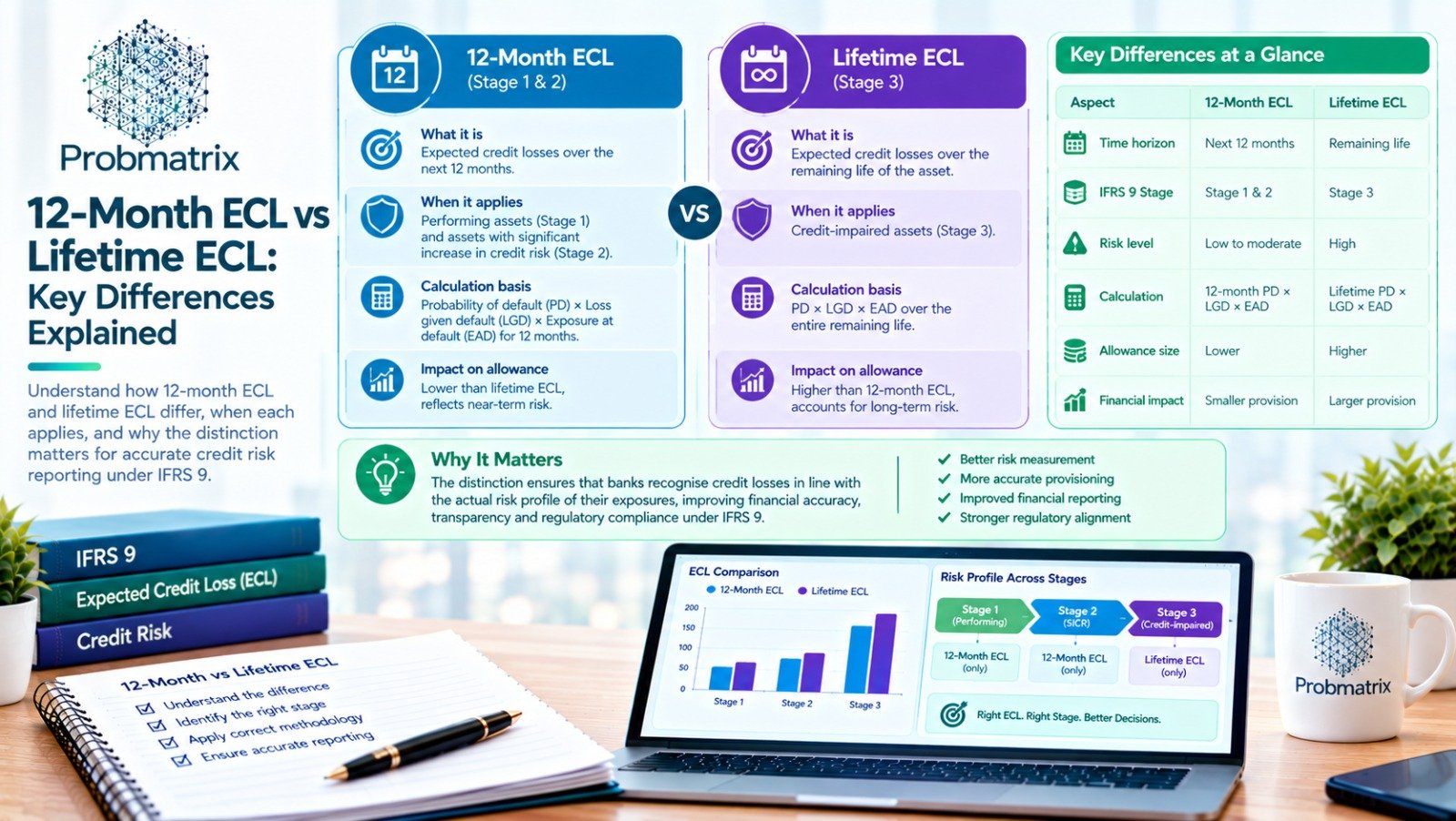
One of the most important concepts under IFRS 9 is understanding 12-month ECL vs lifetime ECL. The difference determines how far into the future an entity should consider possible defaults when measuring expected credit losses.
This distinction is closely linked with the IFRS 9 ECL stages under the General Approach.
What Is 12-Month Expected Credit Loss?
A 12-month expected credit loss represents the portion of lifetime credit losses associated with default events that are possible within the next 12 months.
Under the General Approach, Stage 1 ECL is normally measured on this 12-month basis.
What Is Lifetime Expected Credit Loss?
A lifetime expected credit loss considers credit losses arising from all possible default events over the remaining expected life of the financial instrument.
Rather than restricting the default horizon to the next 12 months, the model considers how credit risk may evolve throughout the life of exposure.
Under IFRS 9, lifetime ECL is generally recognized for exposures classified in Stage 2 and Stage 3.
Stage 1 ECL vs Stage 2 ECL
The distinction between stage 1 ECL and stage 2 ECL is driven mainly by changes in credit risk.
Stage 1 generally applies when credit risk has not increased significantly since initial recognition. The exposure is measured using 12-month ECL.
Stage 2 applies when there has been a significant increase in credit risk since initial recognition. The measurement then moves to lifetime ECL.
Stage 3 also uses lifetime ECL but applies to credit-impaired assets and involves additional accounting considerations.
12 Month ECL vs Lifetime ECL at a Glance
What Changes in the ECL Calculation?
The core building blocks remain the same: Probability of Default, Loss Given Default and Exposure at Default.
The key difference is the time horizon.
For Stage 1, the model considers defaults possible within 12 months. For lifetime ECL, PD, LGD and EAD are projected across the relevant remaining periods of the exposure.
This is why a reliable IFRS 9 framework often requires term structures rather than a single point-in-time estimate.
What About Short-Term Portfolios?
For portfolios with a maximum remaining life of 12 months or less, the numerical difference between 12-month ECL and lifetime ECL may be limited because the full exposure period already falls within one year.
This is particularly relevant for some short-term lending and receivable portfolios.
However, the accounting approach still depends on the applicable IFRS 9 requirements and the nature of the exposure.
The Key Takeaway
The difference between 12-month ECL vs lifetime ECL is primarily about the period over which possible defaults are considered.
Stage 1 typically uses 12-month ECL, while Stage 2 and Stage 3 generally require lifetime ECL.
A well-designed ECL framework should make this distinction clear and ensure that PD, LGD, EAD and forward-looking assumptions are applied consistently across the relevant measurement horizon.