
How to Calculate Lifetime Expected Credit Loss Under IFRS 9
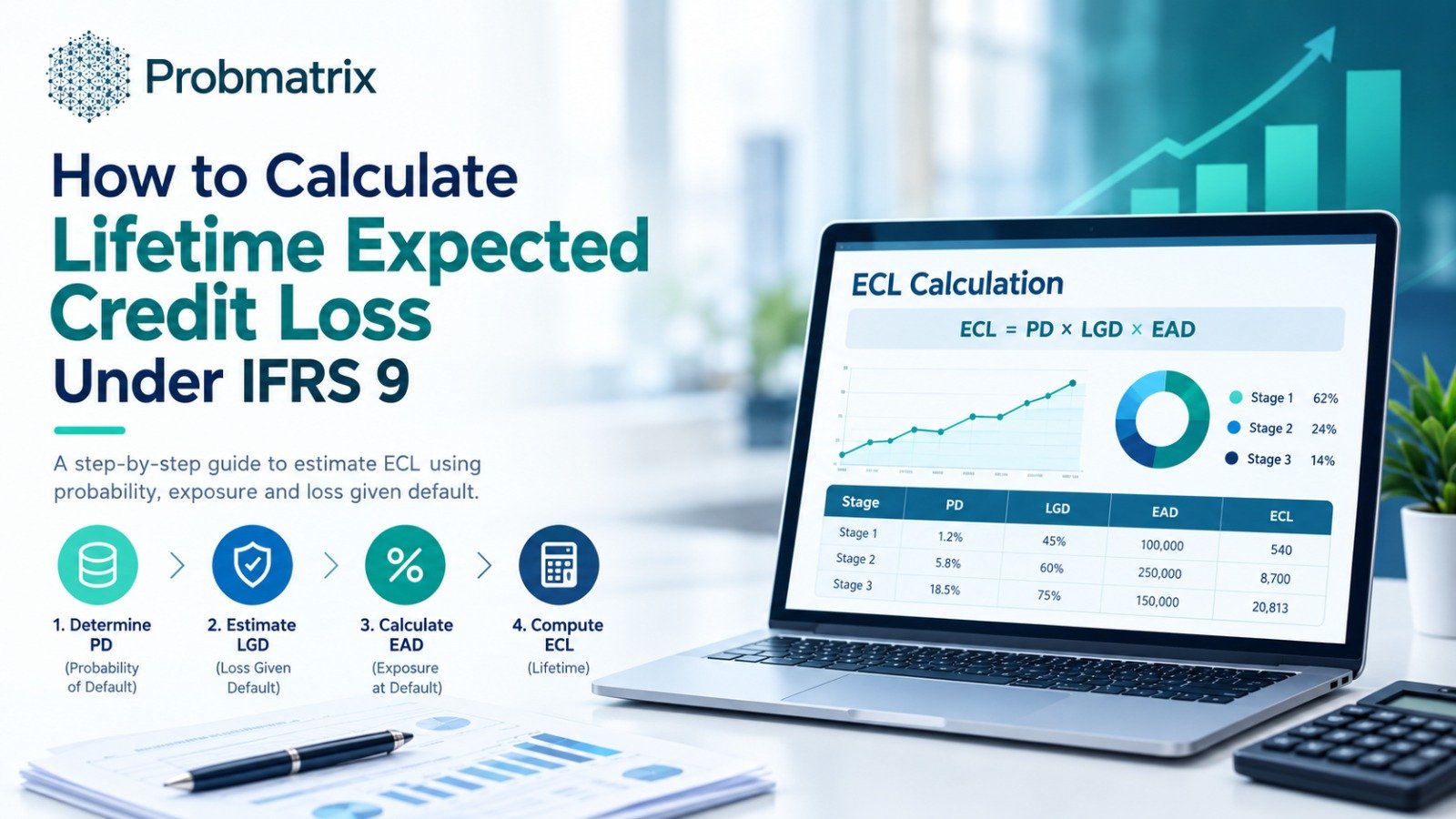
The lifetime expected credit loss calculation under IFRS 9 estimates the credit losses expected over the remaining life of a financial asset. It is a forward-looking measure that considers not only current credit risk, but also how that risk may evolve over time.
In practice, IFRS 9 lifetime ECL is built by projecting credit risk across the expected life of the exposure rather than applying a single loss rate at the reporting date.
What Is Lifetime ECL?
Lifetime ECL represents the expected credit losses resulting from all possible default events over the expected life of a financial instrument.
For exposures under the General Approach, lifetime ECL is typically recognized for Stage 2 and Stage 3 assets, while Stage 1 exposures generally use 12-month ECL.
Under the Simplified Approach, commonly applied to trade receivables and certain other short-term portfolios, lifetime ECL may be recognized from initial recognition.
12-Month ECL vs Lifetime ECL
The key difference between 12-month ECL vs lifetime ECL is the period over which potential default events are considered.
12-month ECL considers losses arising from defaults that are possible within the next 12 months.
Lifetime ECL considers losses arising from defaults over the full remaining contractual or expected life of the exposure.
For very short-tenor portfolios, particularly where the maximum contractual life is around 12 months, the distinction between 12-month and lifetime ECL may become limited because the entire remaining exposure period already falls within one year.
Practical Lifetime Expected Credit Loss Calculation
A practical expected credit loss calculation generally follows these steps:
1. Determine the expected life of the exposure.
The calculation horizon should reflect the period over which the entity remains exposed to credit risk.
2. Estimate the PD term structure.
Probability of Default should be estimated for each relevant future period.
3. Estimate future EAD.
Exposure at Default should reflect how the outstanding balance is expected to change over time. For amortizing loans, this may follow the repayment schedule. For revolving facilities, assumptions may include CCF, behavioral repayments and redraw rates.
4. Estimate LGD.
Loss Given Default should reflect expected recoveries, collateral, cure behavior and the timing of recoveries where relevant.
5. Incorporate forward-looking information.
Historical risk estimates should be adjusted to reflect relevant macroeconomic expectations. This may involve multiple economic scenarios such as baseline, upturn and downturn conditions.
6. Calculate and discount period-by-period losses.
For each future period, the ECL is estimated using the relevant PD, LGD and EAD, then discounted using the appropriate effective interest rate where required.
The final ECL calculation method aggregates these discounted expected losses across the full remaining life of the exposure.
Why Lifetime ECL Is More Than a Formula
A reliable lifetime expected credit loss calculation is not simply:
PD × LGD × EAD
The real challenge is developing a credible term structure for each risk parameter and ensuring that the model responds appropriately to changes in borrower behavior, portfolio characteristics and economic conditions.