
Credit Risk Model Calibration: A Practical Guide
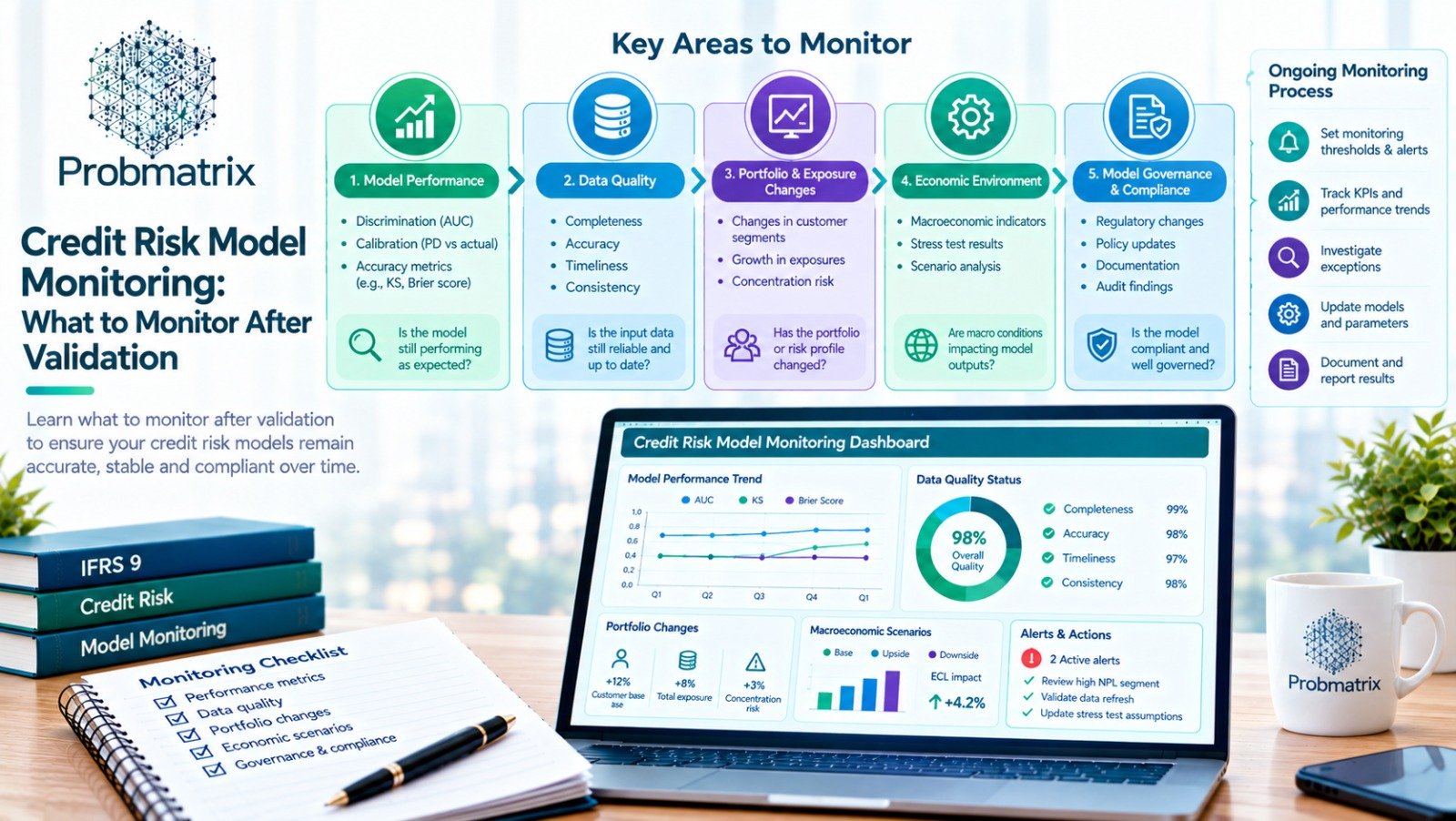
A credit risk model can rank borrowers correctly and still produce inaccurate Probability of Default (PD) estimates. This is where credit risk model calibration becomes important.
Calibration ensures that the PDs produced by a model are appropriately aligned with the portfolio’s actual level of credit risk while preserving the underlying risk differentiation of the model.
What Is Credit Risk Model Calibration?
Probability of default calibration is the process of adjusting model-generated PDs so that they reflect the observed or targeted default experience of the portfolio.
For example, a rating model may correctly identify that Grade A customers are less risky than Grade B customers. However, if the PDs assigned to those grades do not reasonably represent their actual default risk, the model requires calibration.
The objective is therefore not necessarily to change the ranking of borrowers, but to ensure that the PD values attached to that ranking are appropriate.
When Is Calibration Required?
Calibration may be required where:
- The estimated TTC PD curve is non-monotonic across rating grades or risk buckets.
- Model-generated PDs are not aligned with the portfolio's historical default experience.
- The portfolio's central tendency has changed.
- Existing PD estimates systematically overestimate or underestimate observed defaults.
- A new rating model or scorecard needs to be mapped to an appropriate PD scale.
The selected model calibration method should depend on the portfolio structure, availability of default data and the underlying PD estimation methodology.
Practical PD Calibration Techniques
Logit Calibration
Where credit scores or internal risk scores are available and the estimated PDs are non-monotonic, a Logit Calibration approach may be applied to derive a smooth and monotonic PD curve.
Logit Calibration applies a logistic transformation to the estimated PDs and establishes a calibration relationship between the borrower credit score (or internal rating score) and the transformed PD values. The calibrated PDs are then obtained by applying the inverse logistic transformation, resulting in a continuous and monotonic PD curve across the entire score range.
Quasi-Moment Matching (QMM)
QMM calibrates an existing PD curve by aligning it with the portfolio’s central tendency and discriminatory power. It helps maintain the relative risk ordering across rating grades / Buckets while producing a smooth and monotonic PD structure. This makes QMM particularly suitable for both rating-grade PD and Bucket level PD calibration.
Binomial Calibration
Binomial calibration uses the binomial distribution and observed default experience to calibrate PDs, particularly where defaults are limited or unevenly distributed across rating grades. It is useful for low-default or sparse-data portfolios, where direct default-rate estimates may not provide a stable PD curve.
Calibration Testing
Calibration should not end once a new PD curve has been generated. The calibrated estimates should be tested against actual portfolio performance.
Common calibration testing methods include the Binomial Test, Chi-Square Test, Hosmer–Lemeshow Test, Observed-to-Expected (O/E) Ratio and calibration plots.
In simple terms, higher p-values generally indicate better alignment between predicted and observed outcomes, an O/E ratio close to 1 indicates good calibration, and a calibration plot should show predicted and observed default rates reasonably close to the 45-degree line.
Making Calibration Part of Model Governance
Credit risk calibration should not be treated as a one-time model-development exercise. Banks and financial institutions should periodically compare predicted PDs against actual portfolio performance and investigate material deviations.
Changes in portfolio composition, underwriting practices, economic conditions or borrower behavior can cause an originally well-calibrated model to become less representative over time.
A robust calibration framework therefore combines appropriate calibration techniques, statistical testing, expert review and ongoing model monitoring.
Ultimately, effective credit risk model calibration ensures that the PD model does more than rank risk correctly, it ensures that the level of risk being measured is also credible, explainable and suitable for credit risk and IFRS 9 ECL applications.