
Credit Risk Model Validation: What Banks Should Test
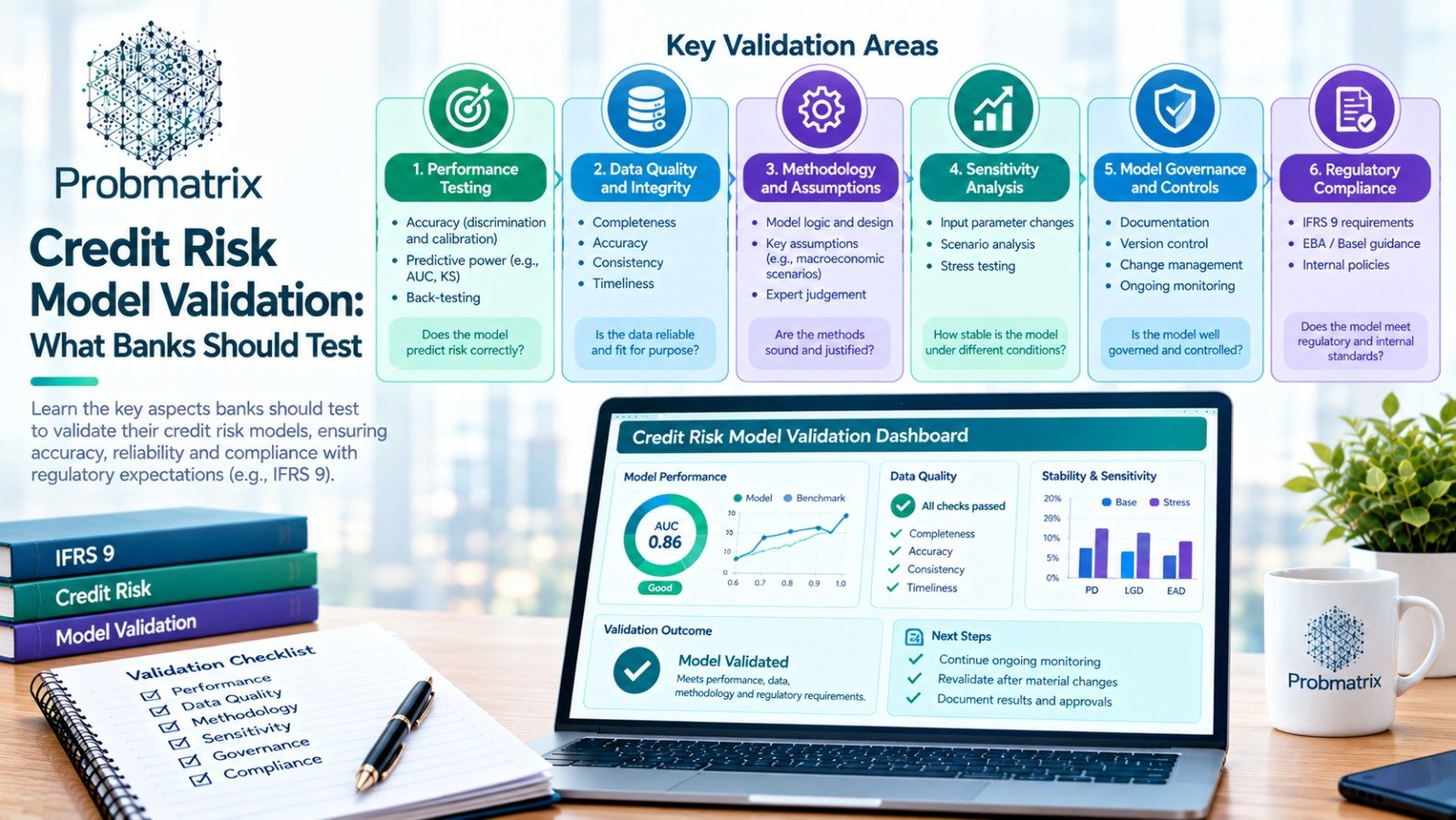
A strong credit risk model validation process helps banks confirm that their models are accurate, stable, conceptually sound and appropriate for their intended use.
For IFRS 9, validation is especially important because ECL depends on several interconnected components such as PD, LGD, EAD, staging, macroeconomic adjustments and scenario weighting.
What Is Credit Risk Model Validation?
Credit risk model validation is an independent assessment of whether a model performs as expected and whether its assumptions remain reasonable.
A good model validation framework should test more than model accuracy. It should also assess data quality, methodology, implementation, stability and governance.
Key Areas Banks Should Test
1. Data Quality
The model validation process should confirm that input data is complete, accurate and consistent with source systems.
Validation should review areas such as:
- Missing values
- Duplicate records
- Default dates
- Exposure balances
- Rating history
- Recovery data
- Delinquency information
Weak data quality can undermine even a well-designed model.
2. Model Performance
Credit risk model testing should assess whether the model can differentiate between higher-risk and lower-risk exposures.
For PD models, common measures may include Binomial, Chi-square, Gini, KS and calibration tests.
For LGD models, performance testing should assess how closely predicted LGD corresponds with actual realized LGD based on observed recoveries and losses. The comparison helps determine whether the model systematically overestimates or underestimates loss severity and whether recalibration is required.
For EAD models, particular attention should be given to the performance of CCF estimates and behavioral assumptions.
3. Calibration
Calibration testing assesses whether estimated PDs are aligned with actual default experience. Common methods include the Binomial Test, Chi-Square Test, Hosmer–Lemeshow Test, O/E Ratio, and calibration plots. In general, higher p-values indicate acceptable calibration, an O/E ratio close to 1 indicates good alignment, and calibration plots should show observed and predicted default rates close to the 45-degree line.
4. Stability
A strong credit risk validation process should test whether model performance remains stable over time.
Population Stability Index, migration analysis and trend analysis can help identify changes in portfolio characteristics or model behavior.
5. Forward-Looking Adjustments
For IFRS 9 models, validation should also assess whether macroeconomic variables, scenarios and probability weightings are reasonable.
The model should respond logically to improving and deteriorating economic conditions.
Validation Is More Than Statistical Testing
A good credit risk model validation process also checks whether:
- The methodology is appropriate for the portfolio
- Assumptions are documented
- Overrides are controlled
- Model limitations are understood
- Calculations are implemented correctly
- Outputs are explainable to management and auditors
Key Takeaway
Credit risk model validation should test the full modelling process, not just the final numbers.
A reliable model validation framework combines data testing, statistical performance, calibration, stability analysis, implementation review and qualitative assessment.
The objective is simple: ensure that the model remains accurate, transparent and fit for purpose before its outputs are used for credit-risk or IFRS 9 decisions.