
IFRS 9 Impairment: A Practical Guide to Building an ECL Model
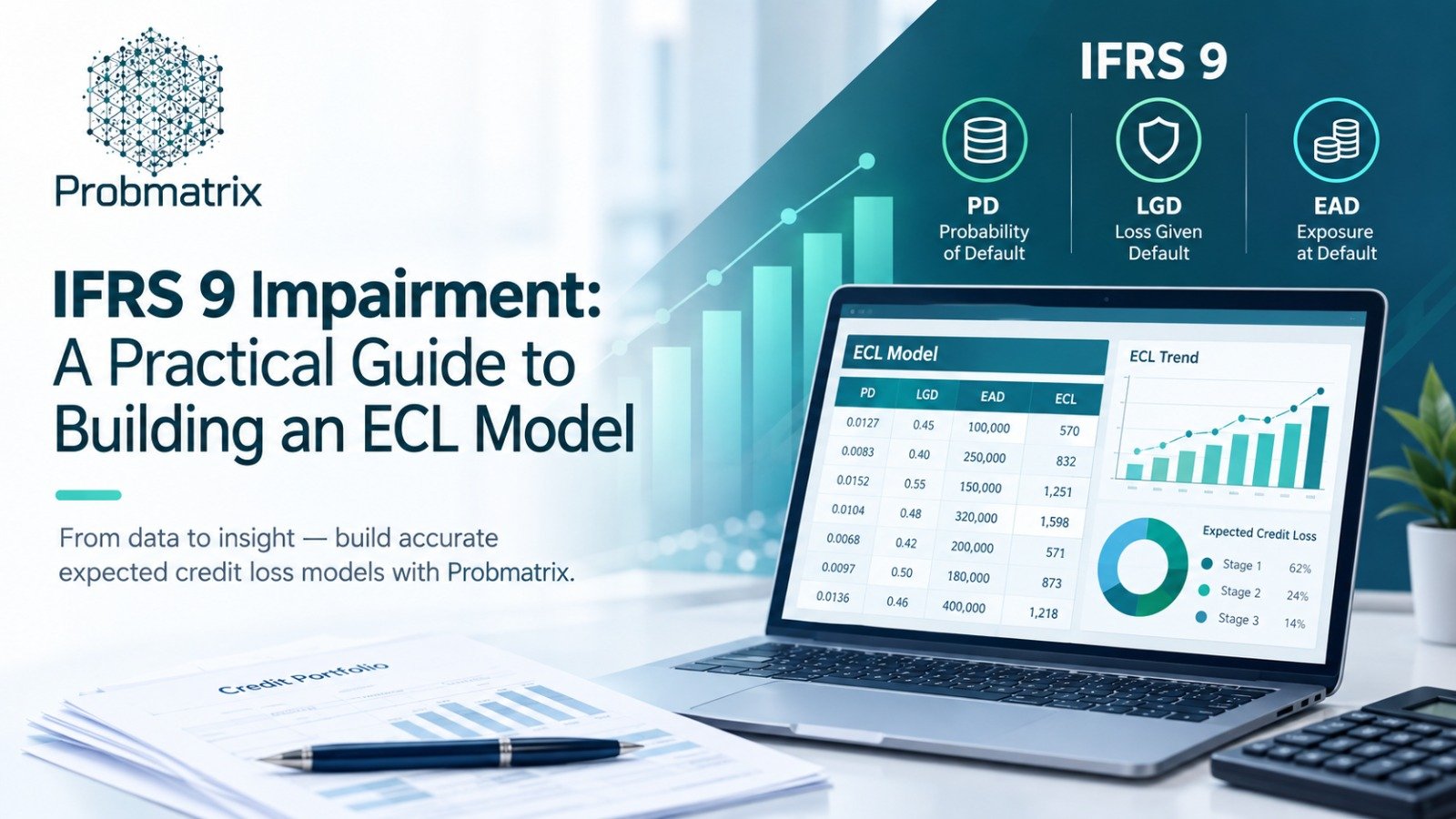
Building an IFRS 9 impairment model is not simply about applying a formula to calculate Expected Credit Loss. A reliable model needs to connect historical credit behavior, current portfolio characteristics and forward-looking economic expectations in a structured and explainable way.
Whether the portfolio consists of corporate loans, retail financing, trade receivables or other financial assets, the objective remains the same: estimate credit losses that reasonably reflect the risk within the portfolio.
How Does IFRS 9 Impairment Model Work?
An expected credit loss model generally brings together three core credit-risk components:
Probability of Default (PD) estimates the likelihood that a borrower or exposure will default over a specified period.
Loss Given Default (LGD) estimates how much of the exposure is expected to be lost if default occurs, after considering recoveries, collateral and the timing of recoveries where relevant.
Exposure at Default (EAD) estimates the amount expected to be outstanding when default occurs. For revolving facilities, this may also require assumptions around future drawings, repayments and Credit Conversion Factors (CCFs).
These components form the foundation of the IFRS 9 impairment calculation, but calculating PD × LGD × EAD alone does not complete the process. IFRS 9 also requires the estimate to reflect the time value of money and reasonable and supportable forward-looking information.
Practical IFRS 9 Impairment Model Steps
A practical IFRS 9 ECL model can be developed through the following process:
1. Understand and segment the portfolio.
Exposures should be grouped based on characteristics that result in reasonably similar credit-risk behavior.
2. Estimate historical credit risk.
Depending on the portfolio and available data, PD may be developed using methods such as observed default rates, migration matrices or roll-rate analysis. LGD and EAD assumptions are developed separately using relevant historical experience.
3. Introduce forward-looking information.
Historical estimates should not automatically become IFRS 9 estimates. Relevant macroeconomic variables need to be identified, tested and incorporated into the ECL framework where they influence credit risk.
4. Develop economic scenarios.
Rather than relying only on a single economic forecast, an entity may consider multiple plausible scenarios, such as baseline, upturn and downturn conditions, and assign appropriate probability weightages.
5. Calculate the ECL term structure.
PD, LGD and EAD are projected over the relevant expected life of the exposure and discounted where required.
6. Validate and document the model.
The final credit impairment model should be tested for performance, stability and economic reasonableness. More importantly, assumptions, adjustments and model outputs should be traceable and explainable.
The ECL Number Is Only the End Result
A strong IFRS 9 impairment model is not defined only by the ECL figure it produces.
The real test is whether the institution can explain where the number came from, from source data and portfolio segmentation to PD, LGD, EAD, macroeconomic assumptions, scenario weightages and final ECL.
In practice, a good IFRS 9 impairment framework should therefore be data-driven, forward-looking, repeatable and auditable.