
IFRS 9 Staging Explained: Stage 1, Stage 2 and Stage 3 ECL
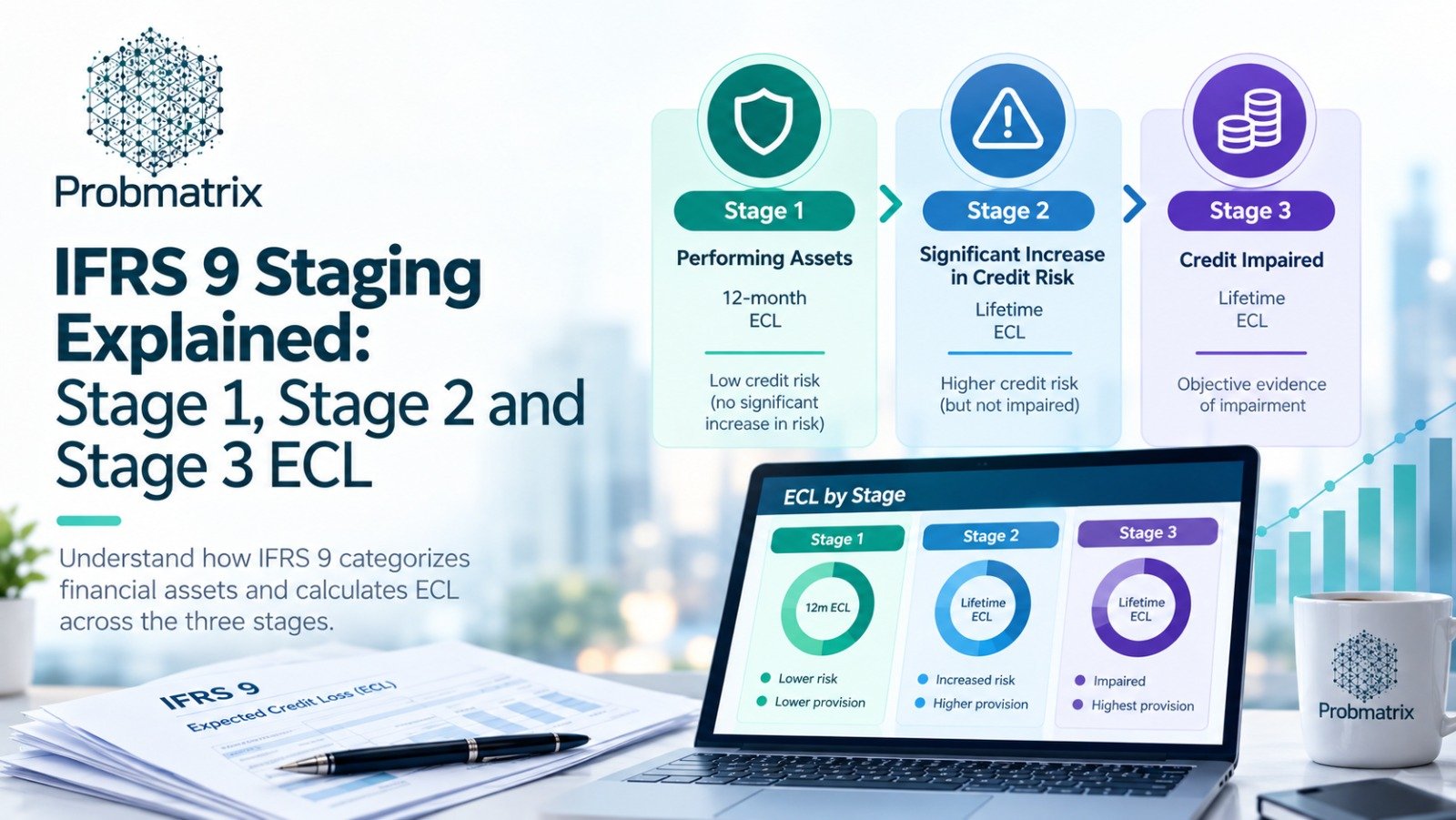
Understanding IFRS 9 staging explained in practical terms starts with one question: how much has the credit risk of an exposure changed since initial recognition?
Under the General Approach, financial assets are classified into Stage 1, Stage 2 or Stage 3. Each stage determines whether the entity should recognize 12-month ECL or lifetime ECL.
What Are the IFRS 9 Stages?
The IFRS 9 stages reflect the deterioration of credit risk over time.
Stage 1 – Performing Assets
Stage 1 generally includes exposures where credit risk has not increased significantly since initial recognition.
For these assets, entities recognize 12-month expected credit loss.
Stage 2 – Significant Increase in Credit Risk
Stage 2 applies when there has been a significant increase in credit risk since initial recognition, but the asset is not yet credit impaired.
Once an exposure moves to Stage 2, the ECL measurement changes from 12-month ECL to lifetime expected credit loss.
This makes the assessment of SICR IFRS 9 one of the most important parts of the staging process.
Stage 3 – Credit-Impaired Assets
Stage 3 generally includes exposures that are credit impaired.
These exposures also require lifetime ECL, but they are treated differently from Stage 2 because there is objective evidence that credit deterioration has already become severe.
How Does SICR Work?
A significant increase in credit risk is assessed by comparing the risk of default at the reporting date with the risk of default at initial recognition.
The assessment should not rely on a single trigger only.
A practical SICR framework may consider factors such as:
- Changes in internal or external credit ratings
- Days past due
- Deterioration in borrower financial performance
- Changes in repayment behavior
- Adverse economic or industry conditions
- Other qualitative signs of increased credit risk
IFRS 9 also includes a rebuttable presumption that credit risk has increased significantly when contractual payments are more than 30 days past due, although entities may rebut this where supported by reasonable and supportable evidence.
Stage 1, Stage 2 and Stage 3 IFRS 9 at a Glance
Why IFRS 9 Staging Criteria Matter
The IFRS 9 staging criteria directly affect the level of impairment recognized.
A movement from Stage 1 to Stage 2 can materially increase ECL because the model moves from a 12-month default horizon to the full remaining life of the exposure.
For this reason, staging should be based on clear, documented and consistently applied criteria rather than simply on days past due.
The Key Takeaway
When looking at stage 1 stage 2 stage 3 IFRS 9, the main difference is the level of credit deterioration and the resulting ECL horizon.
Stage 1 generally uses 12-month ECL. Stage 2 applies when there has been a significant increase in credit risk and requires lifetime ECL. Stage 3 applies once the asset becomes credit-impaired and also requires lifetime ECL.
A strong staging framework should combine quantitative indicators, qualitative information and forward-looking judgement so that changes in credit risk are identified early and consistently.