
LGD Modelling: Methods, Data Requirements and Validation
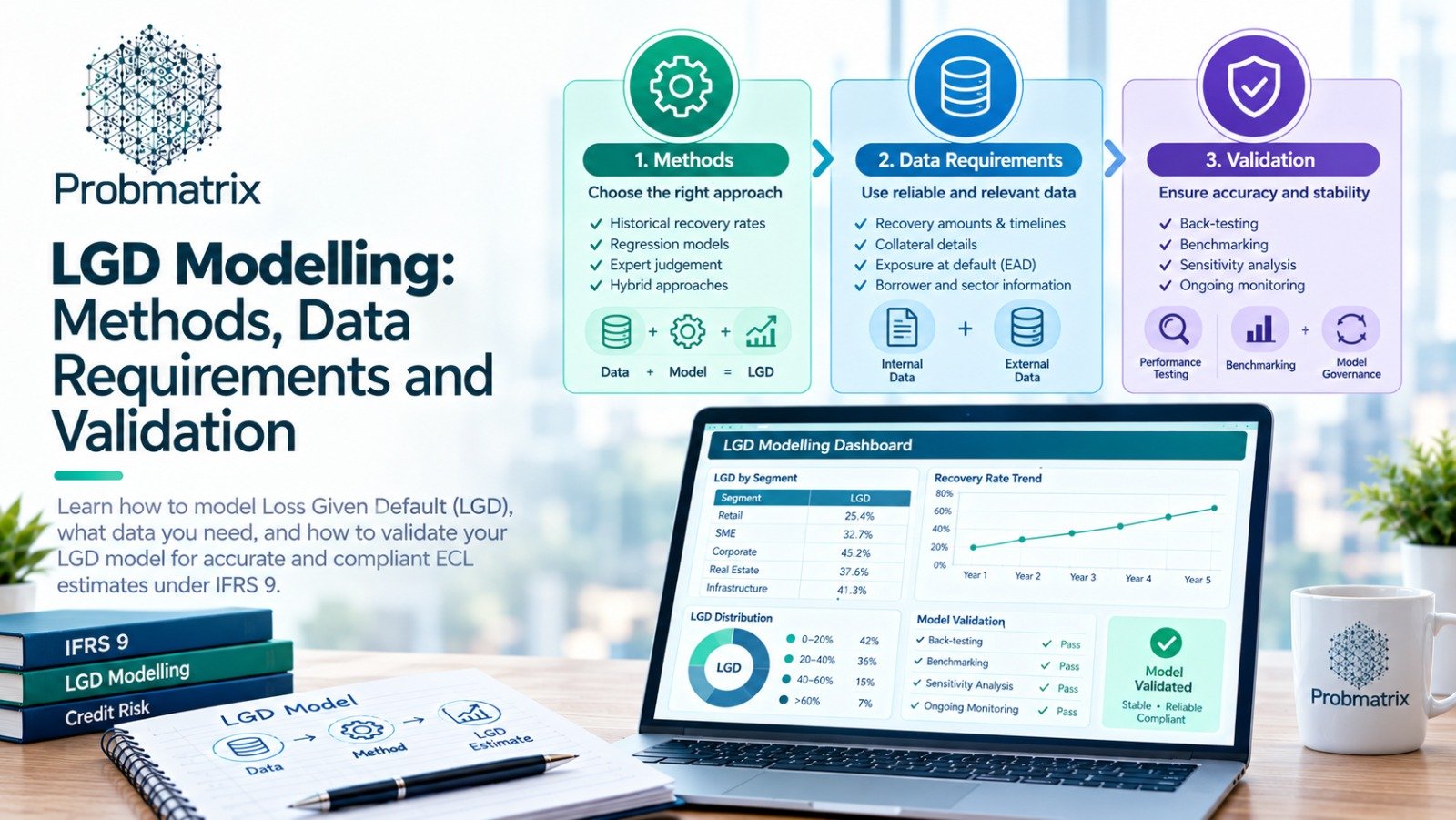
An LGD model estimates the proportion of an exposure that is expected to be lost if a borrower defaults.
Under IFRS 9, LGD is one of the core components of Expected Credit Loss, alongside Probability of Default and Exposure at Default. A strong loss given default model should reflect actual recovery behavior, collateral, recovery timing and forward-looking conditions.
How Is LGD Calculated?
At a simplified level, LGD calculation can be expressed as:
LGD = 1 – Recovery Rate
If an exposure of 100 is expected to recover 60 after default, the LGD would be 40%.
In practice, however, IFRS 9 LGD is more detailed because recoveries may occur over time and may involve collateral proceeds, cash recoveries, legal costs and cure behavior.
Common LGD Modelling Methods
The appropriate LGD modelling methods depend on the portfolio and data availability.
Workout LGD
Workout LGD uses actual post-default recovery experience. It typically considers:
- Cash recoveries
- Collateral recoveries
- Recovery costs
- Time taken to recover
- Cure or return-to-performing behavior
This is one of the most common approaches where sufficient default and recovery history is available.
Collateral-Based LGD
For secured portfolios, LGD may also be estimated using collateral values, haircuts, liquidation costs and expected recovery periods.
The model should avoid assuming that the full collateral value will be recovered immediately.
Benchmark or Proxy LGD
Where historical defaults are limited, institutions may use external benchmarks or conservative proxies, provided the assumptions are reasonable, documented and adjusted as internal data becomes available.
What Data Is Required?
A reliable IFRS 9 LGD framework may require:
- Default dates
- Exposure at default
- Recovery cash flows
- Recovery dates
- Collateral type and value
- Legal and collection costs
- Cure information
- Write-offs
- Restructuring information
The quality of LGD results depends heavily on the quality and completeness of recovery data.
LGD Model Validation
LGD model validation should assess whether the model produces realistic and stable estimates.
Common validation areas include:
- Comparison of predicted vs realized LGDs
- Stability across time and segments
- Sensitivity to collateral assumptions
- Review of recovery timing
- Back testing by portfolio or product
- Assessment of model conservatism
- Review of overrides and expert judgement
Validation should also confirm that the model responds logically when recovery expectations or collateral conditions change.
Key Takeaway
A strong LGD model should capture more than a simple recovery percentage.
It should reflect the amount, timing and cost of recoveries, supported by reliable historical data and reasonable forward-looking assumptions.