
How Macroeconomic Scenarios Affect IFRS 9 ECL
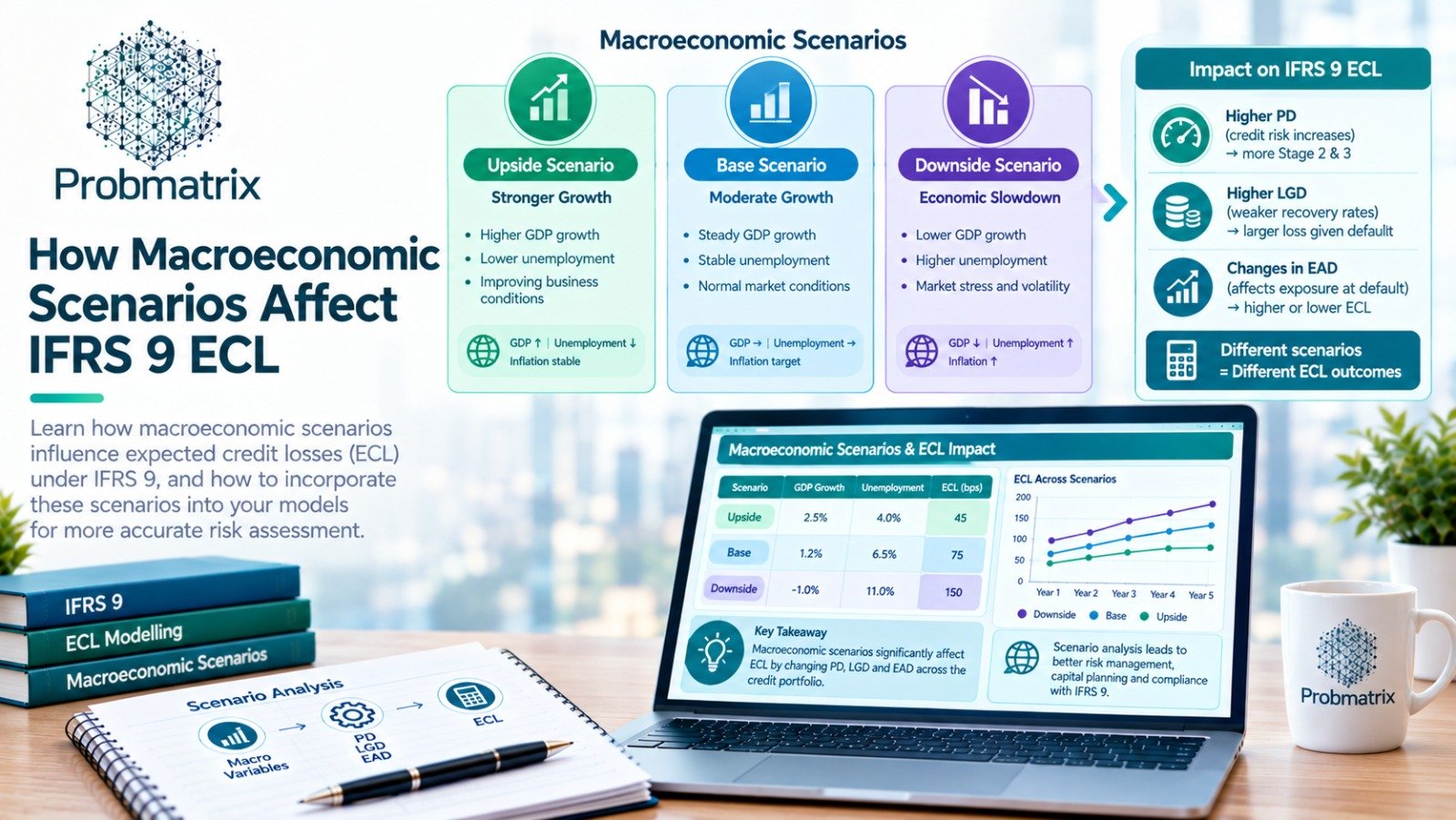
IFRS 9 macroeconomic scenarios are used to make Expected Credit Loss estimates forward-looking rather than purely historical.
Historical default rates can show how a portfolio behaved in the past, but IFRS 9 requires ECL to also reflect reasonable and supportable expectations about future economic conditions.
Why Macroeconomic Factors Matter
Credit risk changes when economic conditions change.
Borrowers may become more likely to default during periods of weak growth, high inflation, rising interest rates or increasing unemployment. Similarly, improving economic conditions may reduce expected credit losses.
This is why macroeconomic variables under IFRS 9 models often consider indicators such as:
- GDP growth
- Inflation
- Interest rates
- Unemployment
- Exchange rates
- Property prices
- Sector-specific economic indicators
The relevant variables depend on the portfolio and should be supported by statistical and economic relationships.
How ECL Macroeconomic Modelling Works
A practical ECL macroeconomic modelling process usually starts by identifying variables that have a meaningful relationship with historical default or loss behavior.
These variables are then used to adjust historical or through-the-cycle credit risk estimates into forward-looking estimates.
For example, if historical analysis shows that default rates increase when GDP declines, a weaker GDP forecast may result in higher forward-looking PDs.
The objective is not to include as many variables as possible, but to use variables that are statistically meaningful, economically logical and relevant to the portfolio.
Using Multiple Economic Scenarios
A single forecast may not capture the range of possible future outcomes.
For this reason, economic scenarios IFRS 9 frameworks commonly use more than one scenario, such as:
Baseline: the most likely economic outlook.
Upside: a stronger-than-expected economic environment.
Downside: a weaker economic environment with higher credit stress.
Each scenario produces a different ECL estimate.
Probability-Weighted ECL
The final ECL is generally calculated using scenario probabilities.
A simplified probability weighted ECL calculation is:
Weighted ECL = (Baseline ECL × Weight) + (Upside ECL × Weight) + (Downside ECL × Weight)
For example, if the baseline, upside and downside scenarios receive weights of 60%, 15% and 25%, the final ECL reflects all three outcomes rather than relying only on the baseline forecast.
Scenario weights should be supportable and reviewed when the economic outlook changes.
Forward-Looking ECL Is More Than a Forecast
A strong forward looking ECL framework requires more than importing GDP or inflation projections into a model.
Institutions should be able to explain:
- Why each macroeconomic variable was selected
- How it affects PD, LGD and ECL
- Why the chosen scenarios are reasonable
- How scenario weights were determined
- Whether the model behaves logically under stress
Key Takeaway
IFRS 9 macroeconomic scenarios connect expected credit loss estimates with the future economic environment.
A reliable framework should combine relevant macroeconomic variables, multiple plausible scenarios and probability weightings in a way that is transparent, statistically supportable and economically reasonable.
The goal is not to predict the economy perfectly, but to ensure that ECL responds appropriately to changes in expected credit conditions.