
PD, LGD and EAD Explained: How the Three Inputs Drive ECL
Understanding PD, LGD & EAD explained is essential for anyone working with IFRS 9 Expected Credit Loss.
These three inputs answer three different questions:
- PD: What is the chance of default?
- LGD: How much could be lost if default occurs?
- EAD: How much exposure will exist at the time of default?
Together, they form the core of an IFRS 9 PD, LGD & EAD framework.
Probability of Default
Probability of Default estimates the likelihood that a borrower will default over a specified period.
Depending on the portfolio and available data, TTC PD may be estimated using methods such as observed default rates, roll-rate analysis, Pluto Tasche, migration matrices or internal rating models.
Under IFRS 9, Through-the-Cycle (TTC) PD typically reflects long-term historical default experience and does not, by itself, fully capture changes in current and forward-looking economic conditions. Therefore, TTC PDs can be adjusted using relevant forward-looking macroeconomic information to derive Point-in-Time (PiT) PDs for each future period over the ECL forecast horizon.
Loss Given Default
Loss Given Default estimates the proportion of exposure that may not be recovered after default.
LGD can be influenced by:
- Collateral values
- Recovery rates
- Recovery costs
- Cure behavior
- Time required to recover cash flows
Because recoveries may occur over several periods, the timing of recoveries can also affect the final loss estimate.
The estimated LGD must also be adjusted at each point in time to reflect the prevailing conditions and relevant forward-looking information.
Exposure at Default
Exposure at Default estimates the amount outstanding when default occurs.
For term loans, EAD may follow the contractual repayment schedule.
For revolving facilities, the calculation can be more complex because customers may make repayments or draw additional amounts before default. In such cases, assumptions such as Credit Conversion Factors, repayment behavior and redraw rates may be required.
How Does the PD LGD EAD Calculation Work?
At a simplified level, the expected loss relationship is:
ECL = PD × LGD × EAD
However, a complete PD LGD EAD calculation under IFRS 9 is usually more detailed.
For lifetime ECL, PD, LGD and EAD may be projected across multiple future periods. The model may also include:
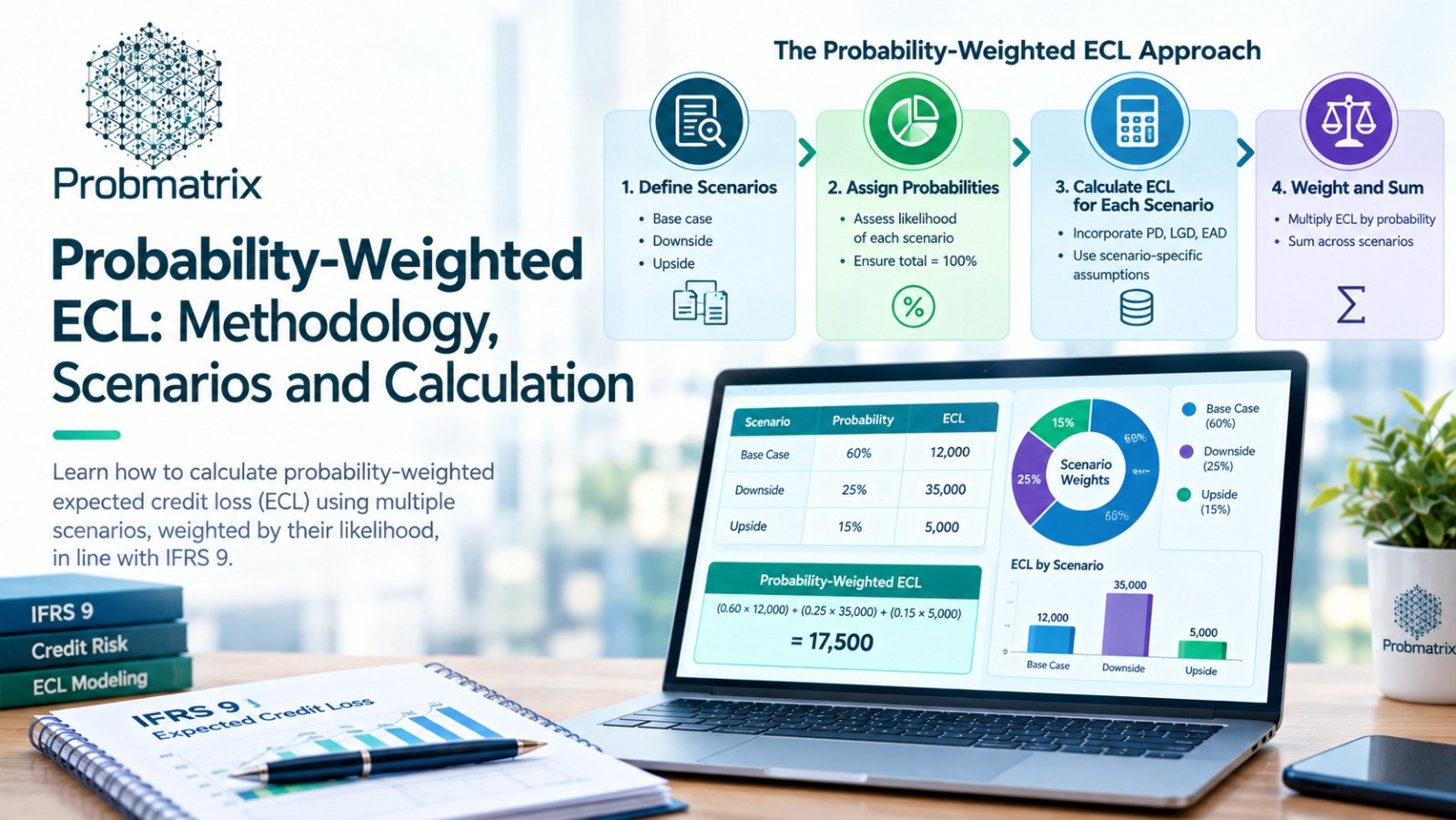
- Multiple economic scenarios
- Scenario weightages
- Expected life
- Discounting using the appropriate effective interest rate
The final ECL is then built from the expected losses across the relevant measurement horizon.
Why the Three Inputs Must Work Together
A highly accurate PD model alone does not guarantee a reliable ECL.
If LGD assumptions are unrealistic or EAD does not properly reflect future exposure, the final impairment estimate can still be distorted.
That is why IFRS 9 PD, LGD & EAD should be developed, validated and monitored as an integrated framework rather than as three isolated models.
Key Takeaway
Probability of default, loss given default and exposure at default measure different parts of credit risk, but they work together to produce Expected Credit Loss.
A strong ECL framework should make each assumption transparent, forward-looking and traceable so that the final impairment number can be explained and defended.