
Significant Increase in Credit Risk (SICR): Methods and Examples
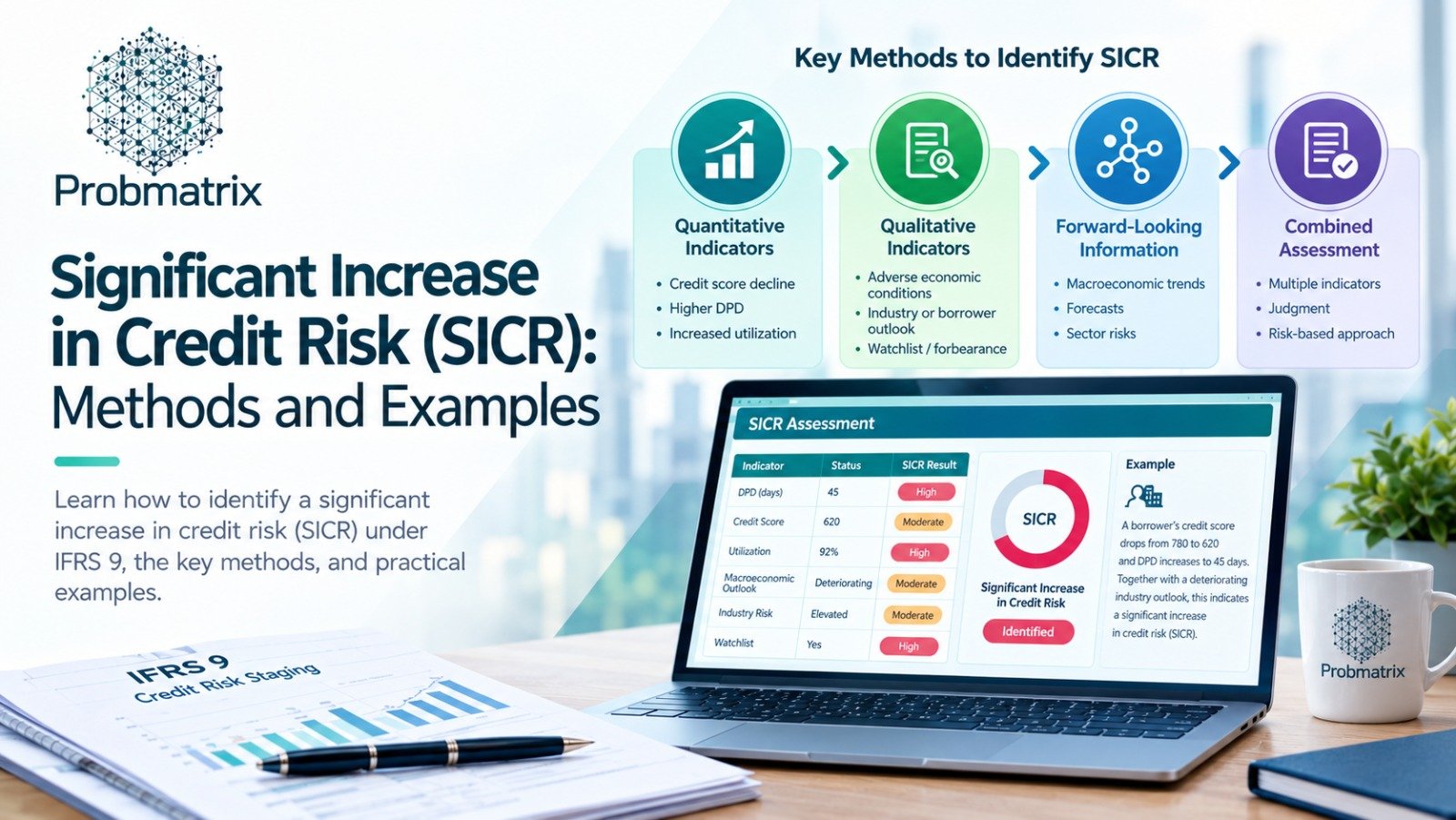
A significant increase in credit risk is one of the most important judgement areas under IFRS 9 because it determines when an exposure moves from Stage 1 to Stage 2.
In practical terms, SICR IFRS 9 asks whether the risk of default has increased significantly since the financial asset was first recognized.
If the answer is yes, the exposure generally moves to Stage 2 and the ECL measurement changes from 12-month ECL to lifetime ECL.
How Does an IFRS 9 SICR Assessment Work?
An IFRS 9 SICR assessment should compare the credit risk at the reporting date with the credit risk at initial recognition.
The assessment should not rely on a single indicator.
A robust SICR framework typically combines quantitative measures, qualitative indicators and backstop criteria to identify deterioration in credit risk at an early stage.
Common SICR Assessment Methods
1. Relative Change in Probability of Default
One common method is to compare the current probability of default with the PD at initial recognition.
For example, if a borrower originally had a low PD but the current PD has increased materially, this may indicate a significant increase in credit risk.
The challenge is that the SICR threshold should reflect the nature of the portfolio. A fixed increase in PD may not be equally meaningful for low-risk and high-risk borrowers.
2. Credit Rating Migration
Changes in internal or external credit ratings can also be used as an SICR indicator.
For example, a borrower moving several rating grades below its original rating may indicate meaningful credit deterioration, particularly where the downgrade results in a significant increase in default risk.
3. Days Past Due
Payment delinquency is one of the most commonly used practical indicators.
IFRS 9 includes a rebuttable presumption that credit risk has increased significantly when contractual payments are more than 30 days past due.
However, 30 DPD should generally be treated as a backstop rather than the only SICR trigger.
4. Qualitative Credit-Risk Indicators
A borrower may experience increased credit risk before becoming overdue.
An IFRS 9 SICR assessment may therefore consider factors such as:
- Deterioration in financial performance
- Reduced liquidity or cash-flow pressure
- Adverse changes in industry conditions
- Negative changes in internal credit assessment
- Expected deterioration caused by economic conditions
These indicators can identify risk before it becomes visible through payment arrears.
A Practical SICR Example
Consider a corporate borrower that was initially assigned a relatively strong internal rating.
At the reporting date, the borrower remains current on payments but has experienced declining profitability, weaker cash flows and a material downgrade in its internal rating.
Even though the account is not yet 30 days past due, these changes may indicate that credit risk has increased significantly since initial recognition.
Under the IFRS 9 staging framework, the exposure may therefore move from Stage 1 to Stage 2, resulting in lifetime ECL recognition.
Choosing an Appropriate SICR Threshold
There is no single SICR threshold that works for every portfolio.
Thresholds should reflect the institution's portfolio characteristics, rating framework, historical credit behavior and availability of information.
The most effective approach is usually to combine several indicators rather than rely only on PD movements or days past due.
The Key Takeaway
SICR IFRS 9 is not simply a 30 day past due test.
A strong SICR assessment method looks for meaningful deterioration in credit risk using quantitative changes, rating movements, payment behavior, qualitative indicators and forward-looking information.
The objective is to identify increased credit risk early enough for the exposure to move from 12-month ECL to lifetime ECL before it becomes credit-impaired.